
A New Cockroach Species Is Spreading Through the Suburbs of the North East.

The Mediterranean Spotted Cockroach, or Tawny Cockroach from Europe, is taking up residency around the suburban homes of Long Island. Scientifically named Ectobius pallidus (Oliver, 1789), the insect was first seen in the U.S. in 1948 in Falmouth, Massachusetts, and stayed in the Cape Cod area until four or five years ago. Around 2019, most likely related to a change in genetically linked behavior, the Mediterranean Spotted Cockroach started hitting the road. The bug appeared in new places on the East Coast, as far south as Virginia and westward to Michigan – but almost exclusively in the suburbs. Unlike the German cockroach, its city-infesting relative, the Mediterranean cockroach, tolerates cold weather and can overwinter and reproduce outdoors. (Roth 1957) Cockroaches are famous for their genetic adaptability to changing environments. Some city roaches have become so tolerant of insecticides that they can eat them straight-up for breakfast. (Collins 2009)
Why is it of interest?
The Mediterranean spotted cockroach can also live inside homes, becoming a pantry pest. So far, few high-level infestations of domiciles by the insect have been reported, but those that do are signaling the possible expansion of their tolerable habitats. CBS said the beasties overran an apartment building in 2019. (CBS 2019) There may be other examples of indoor invasions by this species, but they have likely gone unreported, lacking the insect’s correct identity. Professional exterminators know the difference between the German cockroach and its Mediterranean cousin. In the town of Islip, NY, it seems the time is here to learn the differences between German and Mediterranean cockroaches – to know the enemy.
Video clip of a commonly found house spider, a broad-faced sac spider Trachelas tranquillus, feeding on a Mediterranean Spotted Cockroach.
How to identify a Mediterranean Spotted Cockroach
Adult Mediterranean Spotted Cockroaches are about twenty percent smaller than their city-dwelling cousins. Their color is light tan (another common name for the insect is the Tawny Cockroach), with their backs peppered with tiny black dots. The city-living German species has two black lines on its back. Additionally, the Mediterranean species fly well and are attracted to lights. They usually enter homes through unscreened doors and windows at night. (Smiley 1991)
The good news is that year-round indoor available drinking water is a limiting factor controlling permanent establishment in human domiciles. Unlike German cockroaches, Mediterranean cockroaches do not fear light. This trait makes them easier to spot, but also gives the impression that their numbers are higher than they actually are. Also, they have yet to be selectively bred by insecticide exposure into resistant strains, so bug-killers work well.
Time and genetics have yet to finish their evolutionary wonders in America’s northeast, but this is a land of opportunity
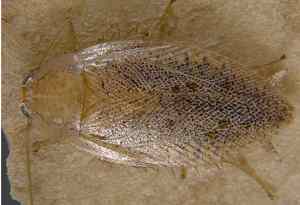

Video of Mediterranean Spotted Cockroach eating a pear.
Advance notice about a new Pokémon cockroach-like character
Not wanting to fall behind Long Island in the novel cockroach competition, the June 23 issue of the Journal of Asia-Pacific Entomology will announce the discovery of a new-to-science roach species in Singapore that looks like a Pokémon character. Foo Maosheng and Cristian C. Lucañas, a team of cockroach hunters, scientifically named the new bug after what they feel it resembles most closely – the Pokémon character Pheromosa.
How to footnote this page: Reiser, Frank W. (2022, October) Mediterranean Spotted Cockroach – Invasive Species In the U. S., https://antiqueslides.net/mediterranean-cockroach
References
CBS News (2019). Residents Complain About Filth in Concord Apartment, San Francisco. March 19, 2019. Available at: cbsnews.com/sanfrancisco/news/residents-complain-about-cockroaches-filth-at-concord-apartment/
Collins, W. J. (2009) Resistance in Blattella germanica: the effect of propoxur selection and non-selection on the resistance spectrum developed by diazinon selection. Published online by Cambridge University Press: July 10.
Roth, Louis M., and Edwin R. Willis (1957). Observations on the Biology of Ectobious pallidus. Transactions of the American Entomological Society, pp 31-37. Stable link at: https://www.jstor.org/stable/25077738
Smiley, R. L., and MA Roach (1991) Insects and Mite Pests in Food, an Illustrated Key. USDA Agriculture handbook (available at) https://www.agriculture.gov.au/sites/default/files/sitecollectiondocuments/ba/memos/1999/plant/TWGP_1.doc